“The shock is too much, the contrast too raw. We should sail or swim or walk from Africa, letting bits of her drop out of us, and gradually, in this way, assimilate the excesses and liberties of the States in tiny, incremental sips…” (Alexandra Fuller, Scribbling the Cat).
Re-entry is what my friends and colleagues call it. It is the physical and emotional experience of traveling from one place in time and space to a distant land on the globe. The actual time it takes to travel the ten thousand miles from Cape Town to Seattle is usually about thirty-six hours. It feels more like travelling to the moon and back. I always feel prepared; I never am.
One would think that travelling between the two places I now call home wouldn’t cause such tension. Both contexts are familiar; I am loved in each location. I am in love with the people and landscape of both tiny dots on the planet. It is never so simple. Returning to friends and family after a year in Africa made me fraught with anxiety. However, once there I soon settled into life like sinking under my favourite childhood blanket- warm, familiar, secure, loving.
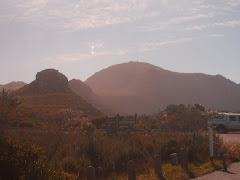
A part of me, as has been for many years now, was still in Africa though. The desire- or need- for the vibrancy of culture or the intensity of dialogue or the serenity of worn mountains and the constant drum-beat rhythm of the Atlantic and Indian Oceans continues. That crazy part of me still yearns for the vibrancy and steel-raw daily existence in Africa. I don’t know when a part of me was laid here to rest, but I am certain that pieces of me are still in Africa. As they are in Seattle. It seems incongruous, even as I think about it.
Fuller’s description is so true and real it is painful. My heart aches for the camaraderie, familiarity and comfort of my life in Seattle. I have the depth of friends there that, unfortunately, many do not know. True friends. Yet, the call of Africa was so strong that it seems in retrospect that the Cape Winds propelled me from my cosy, lovely Seattle life to the rugged tip of Africa. Apparently I was not content with cosy and familiar but in search of challenge and vibrancy in a place on the planet so near and yet so far.
However, the longing of familiarity, of hard-won relationships that are as enduring as Rainier Mountain itself also lingers. The embers of that existence also continues to burn with blue-hot heat. Arriving in the Emerald City added oxygen to the fire. Sinking back into the intensity and boisterousness of my African Life again fans the flame. The trip has made me realize one thing for certain- perhaps something I have known deep inside me for a very long time. I will never again have a singular place that I call home; my existence, my soul, my heart is forever tenuously, inharmoniously stretched between two very far places.
Saturday, July 30, 2011

Tuesday, May 31, 2011
Rules of the Road
Roadway driving in South Africa continues to intrigue me. Firstly, we drive on the left side of the road, I’m sure due to the legacy of British colonialism in the early twentieth century. A traffic light is called a robot. I’m not sure exactly where that comes from, but directions to any location will certainly include references to some robot somewhere so it is an important lesson. Crosswalks exist, but their function is sort of analogous to the death warning on a pack of cigarettes; they don’t really deter people from doing what they want to do. Therefore, there is nothing significant about people playing Frogger as they dodge cars hopping from lane to lane to get to the other side.
The best lesson, however, is that rules of the road are less like rules, and a little more like, say… guidelines. Painted lines differentiating roadway lanes are more like gentle reminders than strict and ardent rules of law. Driving on the shoulder is permissible, even encouraged, to allow another car to pass. Furthermore, it’s much better to step on the throttle while entering a round-about than it is to stop or slow down in effort to be ‘courteous’. Otherwise, you’ll get an earful from other drivers. And hooting- that is, honking ones horn- is highly encouraged… under any circumstance.
And then there’s taxi’s, the deeply loathed lifeblood of South African transportation. In South Africa there’s a big difference between a ‘taxi’ and a ‘cab’. A cab is a for-hire vehicle that takes one person from one location to another location specified by the passenger. A taxi, on the other hand, is a mini-bus that runs along certain routes that may or may not be altered at the discretion of the driver. Taxi’s seat about twelve and often carry about twenty or more through the city to varying suburbs and townships. Now I’m getting to the loathing part.
Any road rule, or even guideline, exempts taxis. And this refers to much more than occupancy levels, which can double- or more- the legal limit. Taxis are the beasts of the highway. They will scream pass you on the shoulder of the freeway in rush hour traffic. Taxis are obliged to cut in front of any car for nearly any reason or at any time. They stop suddenly and without warning in the middle of the roadway to pick up a potential customer. And regardless of the law, one must always yield the right of way to a taxi. These merciless metal brutes rule the road, literally, it’s just the type of South African driving lesson one must learn from experience.
The best lesson, however, is that rules of the road are less like rules, and a little more like, say… guidelines. Painted lines differentiating roadway lanes are more like gentle reminders than strict and ardent rules of law. Driving on the shoulder is permissible, even encouraged, to allow another car to pass. Furthermore, it’s much better to step on the throttle while entering a round-about than it is to stop or slow down in effort to be ‘courteous’. Otherwise, you’ll get an earful from other drivers. And hooting- that is, honking ones horn- is highly encouraged… under any circumstance.
And then there’s taxi’s, the deeply loathed lifeblood of South African transportation. In South Africa there’s a big difference between a ‘taxi’ and a ‘cab’. A cab is a for-hire vehicle that takes one person from one location to another location specified by the passenger. A taxi, on the other hand, is a mini-bus that runs along certain routes that may or may not be altered at the discretion of the driver. Taxi’s seat about twelve and often carry about twenty or more through the city to varying suburbs and townships. Now I’m getting to the loathing part.
Any road rule, or even guideline, exempts taxis. And this refers to much more than occupancy levels, which can double- or more- the legal limit. Taxis are the beasts of the highway. They will scream pass you on the shoulder of the freeway in rush hour traffic. Taxis are obliged to cut in front of any car for nearly any reason or at any time. They stop suddenly and without warning in the middle of the roadway to pick up a potential customer. And regardless of the law, one must always yield the right of way to a taxi. These merciless metal brutes rule the road, literally, it’s just the type of South African driving lesson one must learn from experience.
Democracy in Action
It’s nearly election time in South Africa. The elections taking place are for local appointments following the 2009 national elections that put the African National Congress (ANC) at the helm of the country for the fourth term. Even if one is oblivious to the local news, it is very apparent. Various party posters have begun to spring up on each and every street light and electrical pole. With Election Day nearing, the posters are often three or four deep, each one climbing latterly one on top of the other up the pole. Each poster has the name of the party, a picture and often a slogan of some sort.
I don’t know what they all say, unless I see the exact sign in English. Posters are written, most often but not exclusively, in Afrikaans, Xhosa or English. Other areas with different demographics wield signs in other languages. In a country with eleven official languages, and many more spoken languages, I am getting used to a multi-lingual existence. Television programs are produced in different languages. Many local programmes, and particularly sports, are in multiple languages. So one minute somebody will be speaking is Tswana, the next Afrikaans, next Zulu and then English and finally back to Tswana.
There must be at least as many political parties as there are languages in the country. There is a vigorous engagement in the election process. The political discourse is laden with reminders of the decades-long battle for democracy and freedom. Rhetoric is flung from all political perspectives. One party wants the Western Cape, the province where I live, to secede from the rest of South Africa in effort to “end ANC rule forever”. But the discussion typically revolves around political processes, employment and services, mostly the latter.
There are many differences between the United States elections and South African elections. There will be two ‘positions’ up for grabs; city mayor and local positions broken into wards. Names do not appear on the ballot as only parties are voted into elected positions. In some cases, the party does not even announce who will be assigned the position before the elections. Parties are voted on according to ideological principles and policies. The biggest difference, though, is that voting day is a national holiday in South Africa. And with relatively few holidays, as compared to South Africa, I think that’s a difference the United States could learn from!
I don’t know what they all say, unless I see the exact sign in English. Posters are written, most often but not exclusively, in Afrikaans, Xhosa or English. Other areas with different demographics wield signs in other languages. In a country with eleven official languages, and many more spoken languages, I am getting used to a multi-lingual existence. Television programs are produced in different languages. Many local programmes, and particularly sports, are in multiple languages. So one minute somebody will be speaking is Tswana, the next Afrikaans, next Zulu and then English and finally back to Tswana.
There must be at least as many political parties as there are languages in the country. There is a vigorous engagement in the election process. The political discourse is laden with reminders of the decades-long battle for democracy and freedom. Rhetoric is flung from all political perspectives. One party wants the Western Cape, the province where I live, to secede from the rest of South Africa in effort to “end ANC rule forever”. But the discussion typically revolves around political processes, employment and services, mostly the latter.
There are many differences between the United States elections and South African elections. There will be two ‘positions’ up for grabs; city mayor and local positions broken into wards. Names do not appear on the ballot as only parties are voted into elected positions. In some cases, the party does not even announce who will be assigned the position before the elections. Parties are voted on according to ideological principles and policies. The biggest difference, though, is that voting day is a national holiday in South Africa. And with relatively few holidays, as compared to South Africa, I think that’s a difference the United States could learn from!
Frenetic African Spaces
I’m visiting the United States for the first time in nearly one year. I’m looking forward to the visi- particularly Taco Time, pho soup, and a variety of good beers- … and seeing friends and family, of course! But as I plan for my impending return to the US, I think of the things that I will miss here.
Ironically, I think I will miss the chaos and energy of the movement of people the most. Pedestrians and cars alike move, paradoxically, lethargically and franticly at the same time. I’ll miss adults and children running through the parking lot and streets, or just standing around chatting, indifferent to the moving traffic. Public areas always offer an abundance of stimulation- people moving about laughing, singing and talking. There’s a certain frenetic energy and vibrancy to the choreographed movements to which I am only now beginning to understand the moves.
I will also miss car guards. Car guards exist in nearly every parking lot and most city streets, at least the streets where the government doesn’t have paid employees stalking the streets to procure parking payments. Car guards often offer a nice smile and nod upon exiting the car, no doubt to ensure you acknowledge and compensate them upon your return. They survive only on the tips patrons provide them for ensuring their car is, firstly, there and secondly in working condition upon return. A couple of rands offered upon leaving usually results in another smile and the African tradition of respect by accepting the money with the right hand while the palm of the left hand holds the elbow of the right arm.
South Africa’s social systems maintain a distinct and intact human connectedness. While technology and mechanisation have dominated development in the United States, South Africa continues to invest in labour intensive solutions to day to day operations. This approach makes sense considering the 25 per cent unemployment rate and the enormous numbers of un- and low-skilled citizenry. Regardless, on a busy day when I’m frustrated and grumpy, it’s always nice to see a smiling face appreciative of two or three rands.
Ironically, I think I will miss the chaos and energy of the movement of people the most. Pedestrians and cars alike move, paradoxically, lethargically and franticly at the same time. I’ll miss adults and children running through the parking lot and streets, or just standing around chatting, indifferent to the moving traffic. Public areas always offer an abundance of stimulation- people moving about laughing, singing and talking. There’s a certain frenetic energy and vibrancy to the choreographed movements to which I am only now beginning to understand the moves.
I will also miss car guards. Car guards exist in nearly every parking lot and most city streets, at least the streets where the government doesn’t have paid employees stalking the streets to procure parking payments. Car guards often offer a nice smile and nod upon exiting the car, no doubt to ensure you acknowledge and compensate them upon your return. They survive only on the tips patrons provide them for ensuring their car is, firstly, there and secondly in working condition upon return. A couple of rands offered upon leaving usually results in another smile and the African tradition of respect by accepting the money with the right hand while the palm of the left hand holds the elbow of the right arm.
South Africa’s social systems maintain a distinct and intact human connectedness. While technology and mechanisation have dominated development in the United States, South Africa continues to invest in labour intensive solutions to day to day operations. This approach makes sense considering the 25 per cent unemployment rate and the enormous numbers of un- and low-skilled citizenry. Regardless, on a busy day when I’m frustrated and grumpy, it’s always nice to see a smiling face appreciative of two or three rands.
Sunday, April 10, 2011
Cape Town Stadium and Mexico
I recently had the opportunity to attend a soccer match at the new Cape Town stadium, which was built for the 2010 World Cup. Even at a glance, the Cape Town stadium is gorgeous. The flowing, circular lines that outline the stadium against the backdrop of the Atlantic Ocean make it a beautiful sight to behold. I was told that the design was taken from the shape of a Zulu woman’s hat, which I now notice it strikingly resembles.
The energy in the stadium is electric. The energy fills me with excitement; until a fleeting ping of regret hits me as I close my eyes and imagine the tenable exhilaration that must have permeated the stadium during the World Cup games. A deep breath of the warm summer air brings me back to my own time and space and I find myself in my seat in the upper level of the stadium.
I have been both inspired and appalled by the racially motivated discourse here, but I giggled when I was told that the “wave” has been ascribed a cultural history. The “wave”, that collective action within a stadium that behests fans to stand and lift their arms in sequence as to have the effect of a wave, is apparently Mexican.
I visit my closest ally in the retrieval of information, Wikipedia, to confirm this. Apparently there may be some truth to this. There are rumours that this successive motion of stadium crowds originated in Mexico. Ironically, it does mention that in North America it is referred to merely as the ‘wave’. I’m unsure if this is a case of homogeneity wining again or if perhaps Mexico’s renounced proprietorship was a condition of NAFTA. Regardless, the Mexican Wave went around the stadium five full times before withering out to the distraction of the game… the next beer… or whatever. It’s funny that I had to learn about my neighbouring country while on another continent!
The energy in the stadium is electric. The energy fills me with excitement; until a fleeting ping of regret hits me as I close my eyes and imagine the tenable exhilaration that must have permeated the stadium during the World Cup games. A deep breath of the warm summer air brings me back to my own time and space and I find myself in my seat in the upper level of the stadium.
I have been both inspired and appalled by the racially motivated discourse here, but I giggled when I was told that the “wave” has been ascribed a cultural history. The “wave”, that collective action within a stadium that behests fans to stand and lift their arms in sequence as to have the effect of a wave, is apparently Mexican.
I visit my closest ally in the retrieval of information, Wikipedia, to confirm this. Apparently there may be some truth to this. There are rumours that this successive motion of stadium crowds originated in Mexico. Ironically, it does mention that in North America it is referred to merely as the ‘wave’. I’m unsure if this is a case of homogeneity wining again or if perhaps Mexico’s renounced proprietorship was a condition of NAFTA. Regardless, the Mexican Wave went around the stadium five full times before withering out to the distraction of the game… the next beer… or whatever. It’s funny that I had to learn about my neighbouring country while on another continent!
Hippo Hunt- Okavango Delta Style

I am no stranger to the hippo hunt. In fact, my hippo hunting experience spans two evenings… and a few bottles of wine. However, while in the remote Okavango Delta in Botswana, I was privy to a whole new side of said hippo hunt.
It is the day of our arrival. All eight of us in the tour group, plus tents, food and personal supplies for three days, arrive at our remote island destination in the delta on mokoro’s, a traditional canoe. There were two persons to a mokoro, plus the poler, who stood in the back of the mokoro with a pole about ten feet long that is used to push off the bottom of the shallow delta and propel the mokoro. Six mokoros in all wash up on the shores of the tiny, remote island in the delta about an hour and a half later.
We set up our tents and campsite. Then our local tour guides offer to take us on a game walk. We all hop into our mokoros and we head deeper into the delta. After a short twenty minute ride through the velvet waters and reed-lined aqua highways, we hit land again. It’s another of the hundreds of islands in the delta. We are led on foot through the savannah-like island. During our hour and a half long walk, we encounter a herd of African buffalo and an elephant before we hear the hippos.
The hippopotamus makes a very distinctive sound. It sounds a bit like a large, asthmatic pig with a terrible cold imitating Santa Clause’s ‘ho, ho, ho’s’, times ten. So we know it is them. And they are nearby. Even though I’ve seen them before in the wild, I still fill with a sense of fear and anticipation. Hippo’s are Africa’s deadliest animal and we are hours away from civilization and our only accompaniments are two small African men.
Our African guides are titillated. They lead us through the tall grass and around a large pond. The echoes of the hippos’ calls surround us. Large reeds obscure the snorting hippos creating a very eerie and uneasy sensation. Finally, we are corralled on a small mound in effort to get a better look. I’m just happy to improve my view for securities sake. Suddenly, the slipping sun abruptly hits my consciousness. At the same moment I was contemplating the impending darkness, I noticed- out of the corner of my eye- our African guides bent over in what seemed to be an unusual action in the middle of the African bush while surrounded by hippos.
They had taken their pants off. No, seriously; they took OFF their pants. They quickly began to engage in some sort of choreographed march over the reeds. As they marched their briefs sagged slightly in the behind. I blink in bewilderment. My travel partners and I squint hard to be sure our eyes are feeding our brains the correct information. Soon the choreographed movement reveals its purpose. Our guides were laying down reeds that were obscuring our view of the hippos in water. However, soon blinks turn to giggles and giggles to uncontrollable laughter. Neither our aggregated perplexity nor our outright hysterics interrupted our dedicated guides.
The sun continues to set. The men continue to pat down the reeds. The hippos continue to billow their chuckles. We have no weapon; no flashlight. There are no trails to follow back to camp. Anxiety builds. We talk amongst ourselves. We discuss a plan to explain to our guides that we should be leaving, enlighten them of our imminent perils. But now they are nearly twenty yards into the murky banks of the hippo infested pond. I’m sure NOT going in after them! It seems an eternity until they finally walk back to their pants and nonchalantly pull them over their droopy briefs and start to lead us back to the mokoros.
The walk back was over an hour- most of it in the dark. We walk in a single file line and we huddle so close that I continually step on the person in front of me. I shudder, and then indignantly repeat to my fellow traveller, when one of the guides whispers to me that he doesn’t see well at night so I should keep my eyes peeled for the mokoros! Finally, we make it to the familiar mokoros and they safely whisk us through the liquid thoroughfares to the safety of our campsite. Crisis averted- barely!
The Smoke That Thunders

Victoria Falls is a heart thumping testament to the power of Mother Nature. Victoria Falls is also known by its indigenous name Mosi-o-Junga, which means “the smoke that thunders”. It’s indigenous name is much more apropos. Mosi-o-Junga is on the border of Zimbabwe and Zambia; each contains half the falls within their borders. Mosi-o-Junga is 5,604 feet wide and 354 feet high, roughly twice the size of Niagara Falls. It claims to be the world’s biggest water falls.
Like many of life’s most beautiful wonders, pictures are unable to portray its power and magnificence. The roar of the tons of plummeting water is nearly deafening. As I get closer to the falls, the thunderous rumble intensifies and the air thickens with mist. As near even further, the greener and denser the woodlands lining the trail become.
The spray from the falls is intense. It can rise as high as 2600 feet into the air. It is mid-march, closely approaching the height of peak flood season. The heaviest recorded flow is nearly twice that of Niagara Falls. The mist is so heavy that its thickness obscures much of the falls. I continue down the trail and mist turns to showers and showers to a torrential downpour. But it isn’t truly rain. It’s over a hundred degrees and sunny on this part of the earth today. The downpour is mist that rose high into the air only to succumb to gravity to fall again as raindrops.
The rain is so heavy I can’t even keep my eyes open. I fruitlessly use my hands to wipe my face and eyes, but the water is coming down in buckets. I am completely drenched from head to toe. There is no reprieve. The further I walk on the trails, as I near the falls, the more intense it becomes. Concrete stairs with borders collect the rain to create its own little step-waterfall. I have to take my flip-flops off while walking down one of the stairwells for fear that the fast-running water may wash them away off my feet! On a short metal bridge, Zambia’s Knife-Edge Bridge, which connects one cliff to another, I find half a dozen young, dark Zambian children playing a slip-and-slide. The puddle of water at the end of the bridge is well over my ankle. The rain continues to gush.
The experience is exhilarating. While much of the falls were obscured by the mist, it was almost as if the falls themselves was reaching out to touch me. To top it off, a rainbow lay at nearly every turn as the viscous mist melts into the hot African sun. Magical!
Subscribe to:
Comments (Atom)