Now that I have this beautiful balcony, and the weather has acutely turned summer, I thought it only appropriate to buy my own braai (rhymes with ‘pry’). A braai is synonymous with barbeque, but with a South African flair. It get’s its name from an Afrikaans word for ‘roasted meat’, but the term has been adopted by most all South Africans. Like a barbeque, it refers both to the grill as well as the cooking technique. While burgers aren’t unheard of, most commonly a braai would include boerewors (South Africa sausage), chicken or pork.
Another popular outdoor cooking style is the potjie (pronounced poi-key), which means ‘small pot’ in Afrikaans. It is the South African version of the Dutch Oven. While the modern form of the Dutch Oven has many shapes and sizes, in South Africa it is typically a cast iron, three legged pot that is placed directly over hot coals. It requires a fair amount of experience and skill as food must be layered to ensure the contents are cooked evenly. A potjie often includes a meat and then is layered with a variety of vegetables including potatoes, squash, mushroom, peppers, and onions among others things as per ones preferences. Spices and, sometimes, coconut milk is added. Its flavours reflect the South Africans’ love of entertaining over a meal and the diverse cultures in the area.
Outdoor cooking is an important part of life in South Africa, particularly because it is very warm during the long summers and it is practical to cook outside. Many upscale homes have full brick braai’s inside the home or built as part of their back porch. Gas is rarely used, and most often traditional wood coals are used for braai’s. However, charcoal is also becoming popular. Although this requires a considerable amount of time for the coals to become properly heated—before coming here, I can’t remember the last time I used actual coals!!- it provides plenty of time to chat and drink wine and fully participate in the lively discussion South Africans offer.
Tuesday, February 8, 2011

Sunday Walk
I decide to walk one brilliant Sunday morning from my place in Muizenberg to Kalk Bay and back via Boyes Drive. This is an incredibly beautiful, and historic, walk that was recently introduced to me. It follows the coastline of the Cape Peninsula and then the scenic Boyes Drive that scales Muizenberg Mountain for the most spectacular views. At the suggestion of a friend, earlier in the week I grabbed a book at the local library to learn more about the area’s history. I throw a plum and a pear in a small back pack with my book and a few rands (South African currency) and follow the beach southward.
I walk the twenty five minutes to Surfers Corner, the most popular beach in Muizenberg and as I arrive I hear a siren. It is the kind of siren that reminds me of school earthquake drills. I see dozens of surfers and people of all ages standing on the sand looking towards the beach. This beach has lifeguards at bay as well as look-outs from Boyes Drive who are there to spot sharks in the water. The siren indicates that sharks were spotted- a recent news article had claimed several shark spottings in the area, presumably due to the warm weather and ripe feeding grounds. The flag that indicates a shark has been spotted within the last two hours flapped in the wind. I gaze intently in the water, excitedly hoping to a shark fin, but to no avail.
As onlookers continue to stare at the water, I move onward. The area is rich with a history and I look forward to exploring it first-hand. It is said to have started in the late seventeenth century. In the mid-1700’s the Dutch East India Company had a military post under command of Sergeant Muys, after which the area took its name- Muysenburg. Later the spelling was changed to Muizenberg.
Although Kalk Bay had been established as an important fishing village for some time, this part of the Cape Peninsula grew to be an important destination spot for the wealthy during the nineteenth century. By 1883 the railway, still in use today, extended from Cape Town to Kalk Bay, increasing access and promulgating its prosperity. Several homes with names like “Coolarty”, “Villa Capri”, “Rust-en-Vrede” and “Melrose” were built during this time, and still remain. John Cecil Rhodes built a home along the beach, where he later died in 1902.
But probably the most notable historical event is the Battle of Muizenberg. A small billboard supported by the Cape Town municipality marks the site. The battle happened in 1795 and last only two hours and had few casualties, but it had a lasting impact on South Africa. The British, in part due to threat of Napoleon’s military might taking over the prosperous route from India to the Old World, attacked the current occupiers of the Cape, the Dutch East India Company. The Dutch East India Company’s fort was built so close to the sea that four British battleships pummelled the fort, quickly forcing the Dutch to abandon. It was this battle that led to the First British Occupation and it laid the grounds for the Second British Occupation in 1806. Fortunately for me, this is the reason that South Africans speak English rather than French!
I continue on my walk past the trendy and lively Kalk Bay. I walk up Boyes Drive and follow the narrow sidewalk that offers breath taking views of False Bay. Along the way I stop and eat my plum and once again thumb through the pages of my book, looking at photos and thinking how, in many ways, the area hasn’t changed much at all in over two hundred years. I continue to walk and pass the small thatched canopy that shades the shark spotters, who intently look towards the sea. I return home three hours later, burned from the sun but energized by the rich history and striking beauty of the area.
I walk the twenty five minutes to Surfers Corner, the most popular beach in Muizenberg and as I arrive I hear a siren. It is the kind of siren that reminds me of school earthquake drills. I see dozens of surfers and people of all ages standing on the sand looking towards the beach. This beach has lifeguards at bay as well as look-outs from Boyes Drive who are there to spot sharks in the water. The siren indicates that sharks were spotted- a recent news article had claimed several shark spottings in the area, presumably due to the warm weather and ripe feeding grounds. The flag that indicates a shark has been spotted within the last two hours flapped in the wind. I gaze intently in the water, excitedly hoping to a shark fin, but to no avail.
As onlookers continue to stare at the water, I move onward. The area is rich with a history and I look forward to exploring it first-hand. It is said to have started in the late seventeenth century. In the mid-1700’s the Dutch East India Company had a military post under command of Sergeant Muys, after which the area took its name- Muysenburg. Later the spelling was changed to Muizenberg.
Although Kalk Bay had been established as an important fishing village for some time, this part of the Cape Peninsula grew to be an important destination spot for the wealthy during the nineteenth century. By 1883 the railway, still in use today, extended from Cape Town to Kalk Bay, increasing access and promulgating its prosperity. Several homes with names like “Coolarty”, “Villa Capri”, “Rust-en-Vrede” and “Melrose” were built during this time, and still remain. John Cecil Rhodes built a home along the beach, where he later died in 1902.
But probably the most notable historical event is the Battle of Muizenberg. A small billboard supported by the Cape Town municipality marks the site. The battle happened in 1795 and last only two hours and had few casualties, but it had a lasting impact on South Africa. The British, in part due to threat of Napoleon’s military might taking over the prosperous route from India to the Old World, attacked the current occupiers of the Cape, the Dutch East India Company. The Dutch East India Company’s fort was built so close to the sea that four British battleships pummelled the fort, quickly forcing the Dutch to abandon. It was this battle that led to the First British Occupation and it laid the grounds for the Second British Occupation in 1806. Fortunately for me, this is the reason that South Africans speak English rather than French!
I continue on my walk past the trendy and lively Kalk Bay. I walk up Boyes Drive and follow the narrow sidewalk that offers breath taking views of False Bay. Along the way I stop and eat my plum and once again thumb through the pages of my book, looking at photos and thinking how, in many ways, the area hasn’t changed much at all in over two hundred years. I continue to walk and pass the small thatched canopy that shades the shark spotters, who intently look towards the sea. I return home three hours later, burned from the sun but energized by the rich history and striking beauty of the area.
The Nascent Cloud
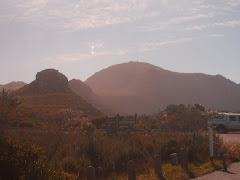
I live a magical part of the world. I live where the mountains kiss the sea; where cultures collide, sometimes with tragic and other times with beautiful, consequences; where clouds are born. I live next to the mountain range which begins at Table Mountain, which is the striking mountain that borders Cape Town. Its unmistakable table-flat top has become the city’s unmistakable landmark. Often on Table Mountain is what is referred to as the ‘table cloth’ or the mountains ‘blanket’. I learned that the scientific name for this is orographic clouds. They are created when the wind is quickly directed laterally up the steep mountain, causing clouds to form quickly as moisture condenses as it gains altitude and temperatures drop. Clouds lay there, concealing the top of the mountain, but just beneath the top the clouds will dissipate, leaving the rest of the mountain clear from miles.
I, however, live on the southern part of this mountain range, the Cape Peninsula. The Cape Peninsula extends into the Atlantic Ocean for nearly fifty miles; at its end are Cape Point and the Cape of Good Hope. Here exists a stunning combination of mountains and sea and the south-western tip of Africa, a mere 120 miles from the southernmost tip of Africa (Cape Agulhas) and where the Atlantic and Indian Oceans meet. It is here that I have witnessed clouds being born. I don’t understand why it happens just above Muizenberg Mountain, but I do know that as the mountains and sea collect warmth from the sun, warm moist air collects. As more air amasses, it will rise until it collides with air cold enough to condense the moisture into a cloud.
I bear witness to this creation. And it is amazing. I will look into the air and see a stream of clouds moving in the direction of the wind. As I watch, the formation of clouds will gracefully creep over the mountains. I think of finding images of animals and other objects, but it continues to stretch, getting fuller and thicker as it moves through the sky. It’s analogous to the clown pulling handkerchiefs from his sleeve, just as it appears impossible for more to come- seemingly from nowhere- the clown pulls another twenty out. Literally the clouds form right in front of my eyes, seemingly from nowhere, but as the clown demonstrates, and science proves, there is more going on than meets the eye.
I, however, live on the southern part of this mountain range, the Cape Peninsula. The Cape Peninsula extends into the Atlantic Ocean for nearly fifty miles; at its end are Cape Point and the Cape of Good Hope. Here exists a stunning combination of mountains and sea and the south-western tip of Africa, a mere 120 miles from the southernmost tip of Africa (Cape Agulhas) and where the Atlantic and Indian Oceans meet. It is here that I have witnessed clouds being born. I don’t understand why it happens just above Muizenberg Mountain, but I do know that as the mountains and sea collect warmth from the sun, warm moist air collects. As more air amasses, it will rise until it collides with air cold enough to condense the moisture into a cloud.
I bear witness to this creation. And it is amazing. I will look into the air and see a stream of clouds moving in the direction of the wind. As I watch, the formation of clouds will gracefully creep over the mountains. I think of finding images of animals and other objects, but it continues to stretch, getting fuller and thicker as it moves through the sky. It’s analogous to the clown pulling handkerchiefs from his sleeve, just as it appears impossible for more to come- seemingly from nowhere- the clown pulls another twenty out. Literally the clouds form right in front of my eyes, seemingly from nowhere, but as the clown demonstrates, and science proves, there is more going on than meets the eye.
Subscribe to:
Comments (Atom)